
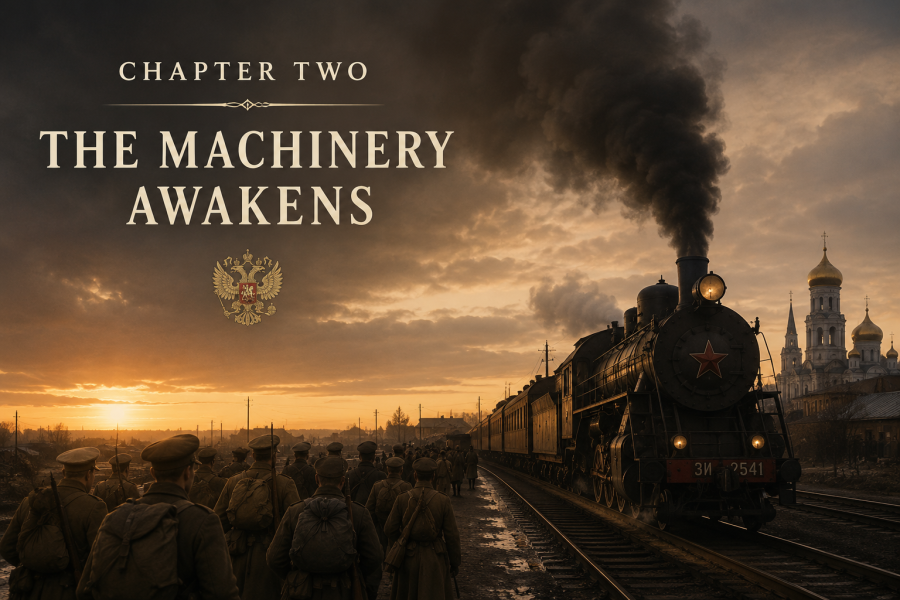
It was not the first time Dmitri had found his convictions colliding with his emotions.
Until now, the contradictions had been manageable. He had argued with classmates over politics, refused to cheat on examinations when others did so routinely, walked away from drunken fights outside dormitories, and listened politely while relatives praised President Putin as the only man keeping Russia from chaos. Principles were easy enough to maintain when nothing truly demanded a sacrifice.
But history had a way of testing ideas that books never could.
He had grown up believing that war belonged to another century. Russia fought terrorists in the Caucasus, advisers served in Syria, mercenaries appeared in Africa under mysterious circumstances, but these were things one watched on television between football matches and weather reports. They were distant, compartmentalized, almost abstract.
Now something was changing.
He could not have explained exactly what.
The newspapers spoke of NATO expansion, sanctions, military exercises in Eastern Europe, cyberattacks, and deteriorating relations with Washington. Every evening the television promised that Russia was surrounded by enemies who wished to humiliate her. Dmitri distrusted much of the rhetoric, yet he sensed beneath it a current that felt real enough.
Then there had been the strange story from Kenya.
For several days every news outlet carried photographs of the American singer Demi Lovato, reported missing during a humanitarian visit somewhere near the Maasai Mara. Russian television mentioned the disappearance briefly before returning to domestic politics. Western networks, however, seemed unable to speak of anything else.
He paid little attention.
Celebrities disappeared from the headlines as quickly as they entered them.
Still...
Something about the story lingered.
Not because he knew her music particularly well, but because it seemed oddly out of place. Humanitarian missions, East Africa, missing persons, diplomats, satellite imagery—it all sounded less like entertainment news than the opening chapter of something no one yet understood.
He folded the newspaper and put it away.
Whatever had happened in Kenya had nothing to do with him.
Or so he believed.
Even during the long bus ride north from Mineralnye Vody, his decision remained unfinished. He still intended to speak with Konstantin in Rostov before committing himself. Konstantin had completed his military service only a few years earlier and possessed a practical way of looking at the world that Dmitri respected.
Perhaps he would laugh at the whole idea.
Perhaps he would tell him to finish university and stay as far away from government service as possible.
Or perhaps...
The possibility refused to leave him.
Anna had certainly failed to talk him out of it.
As she challenged every reason he offered, Dmitri realized that none of her arguments answered the uneasiness he carried inside him. She could criticize politicians, denounce propaganda, ridicule patriotism, even accuse him of surrendering his independence—but she could not explain why he increasingly felt that Russia was approaching a crossroads from which there would be no easy return.
He had parted from her more determined than before.
Anna herself was another matter.
Had circumstances been different, he might have spent the afternoon wandering Pyatigorsk with her, drinking coffee beneath the chestnut trees, talking until the station lights came on. The temptation had been genuine.
He smiled despite himself.
She had changed.
Not merely in appearance, though she had become more confident, more assured than the shy girl he remembered. There was steel in her now. She challenged him instead of agreeing with him. She interrupted. She argued. She expected answers.
He admired that.
He also feared she might be right.
The overnight train to Rostov was crowded. Students returning to universities shared compartments with businessmen, conscripts, tourists, families carrying oversized luggage, and elderly pensioners determined to sleep despite the constant vibration of the rails.
From the narrow upper berth Dmitri stared into the darkness beyond the window.
Sleep refused to come.
The rhythm of the wheels seemed to repeat the same question over and over.
Go... or stay.
He thought of Anna.
He thought of home.
He thought, unexpectedly, of the missing American singer somewhere in Kenya, whose fate no one yet knew.
By morning, he told himself, the world would probably have forgotten her.
He closed his eyes.
Outside, the train continued north through the darkness, carrying him toward a future neither he nor anyone else aboard could possibly imagine.
Meeting Anna had only made him more unsettled.
As the train rolled north through the darkness, Dmitri found himself replaying every moment on the station platform. He should have stayed with her. He should have boarded a train back to Pyatigorsk. They could have walked the boulevard until midnight, arguing about politics and laughing at one another's certainty. Perhaps he would have forgotten all about Rostov.
Instead he lay awake in the crowded carriage, wondering whether he had just walked away from the most important encounter of his life.
The compartment was stifling. Every berth was occupied. Someone snored below him. Somewhere farther down the carriage a baby cried before finally falling asleep against its mother's shoulder. Every few stations passengers climbed aboard carrying shopping bags, military duffels, or cheap plastic suitcases held together with tape.
Dmitri occupied the narrow upper bunk beside the window. He lowered it a few centimeters despite the conductor's warning that the night air would make the compartment cold.
The cool wind was welcome.
He watched the lights of villages slide past like isolated islands in the darkness.
Occasionally he recognized a station before the train stopped. He had traveled this line often enough to know the sequence by memory—Nevinnomyssk, Armavir, Kropotkin, Tikhoretsk...
Southern Russia.
Home.
He loved these plains.
They lacked the dramatic grandeur of the Caucasus, yet there was something reassuring in their openness. Wheat fields stretching beyond the horizon. Shelterbelts of poplar and birch. Small Orthodox churches rising unexpectedly above villages that looked unchanged since Soviet times.
His grandparents had farmed here.
His parents still did.
Yet every year he spent at university widened the distance between himself and the world that had raised him.
When he returned home, neighbors still asked whether he planned to become an engineer, a teacher, or "one of those Moscow intellectuals." His father increasingly avoided political discussions altogether. His mother simply wanted him somewhere safe.
None of them understood the Russia he encountered online.
Telegram channels.
Independent journalists.
Military bloggers.
Opposition commentators.
Government spokesmen.
Foreign analysts.
Everyone insisted they alone understood where the country was heading.
No two visions resembled one another.
He remembered one evening at university when an elderly history professor had closed his notebook and looked around the lecture hall.
"Every generation believes history has ended," the professor had said. "Then history politely reminds them it has not."
The remark had seemed philosophical at the time.
Now it lingered.
Earlier that afternoon, while waiting for the train, Dmitri had noticed another television crew gathered around the station café. CNN was broadcasting live from Nairobi. The scrolling headline beneath the reporter read:
SEARCH CONTINUES FOR MISSING AMERICAN SINGER.
Passengers barely glanced at the screen.
A few shrugged.
Someone muttered that celebrities always managed to find attention.
Within minutes everyone had returned to discussing football, gasoline prices, and university admissions.
Dmitri had done the same.
Whatever was happening in Kenya belonged to another world.
By tomorrow, he assumed, either the singer would be found alive or the story would disappear beneath newer headlines.
History, he reflected, rarely announced itself in advance.
It arrived disguised as ordinary news.
The train raced through the darkness.
Unable to sleep, Dmitri stared through the glass as the eastern horizon slowly turned gray.
He loved Russian dawns.
Unlike the dramatic sunrise over the Caucasus, morning here unfolded almost imperceptibly. The darkness dissolved field by field until telephone poles, abandoned grain silos, and distant tree lines emerged from the mist. Then, suddenly, sunlight spilled across thousands of hectares of wheat, transforming the landscape into sheets of pale gold.
He remembered visiting Yasnaya Polyana during his second year at university.
Not because he agreed with everything Tolstoy had written—far from it—but because he wanted to understand how one man could influence generations without ever commanding an army or holding political office.
He had wandered alone beneath the birch avenues before the estate opened to tourists.
The place possessed an unsettling stillness.
He found himself wondering what Tolstoy would have made of twenty-first-century Russia.
Social media.
Television propaganda.
Cyber warfare.
Private military companies.
Young men trying to decide whether serving the state was an act of patriotism or surrender.
The question remained unanswered.
The first rays of sunlight crossed the compartment.
Passengers stirred awake.
Someone switched on a phone and immediately began scrolling through the morning headlines.
A notification flashed across the screen.
KENYA SEARCH ENTERS FIFTH DAY. NO BREAKTHROUGH REPORTED.
Dmitri looked away.
He had no idea why the story continued to occupy a corner of his thoughts.
Perhaps because, despite everything, it no longer felt like entertainment news.
It felt like something waiting to happen.
He had never been certain of himself.
Each year at university seemed only to reveal another continent of things he did not know.
When he first arrived in Moscow from the south, he imagined education meant accumulating facts. Instead, it dismantled certainties.
One professor insisted that Russia's future depended upon embracing Europe.
Another argued that Europe had already entered irreversible decline.
One economist praised globalization.
The next condemned it as a new form of imperialism.
Military historians debated whether the Cold War had truly ended or merely changed shape.
Every lecture overturned another conclusion.
Books no longer offered comfort. They became adversaries.
Every author seemed persuasive until the next one dismantled him.
For a time Dmitri had admired Solzhenitsyn.
Then came Sakharov.
Then Berdyaev.
Then Huntington.
Then George Kennan.
Then contemporary Russian military theorists writing about "hybrid warfare."
Each appeared convincing while he was reading him.
By graduation he had become suspicious of certainty itself.
Perhaps that was what adulthood meant.14Please respect copyright.PENANAr8tdBQ42Gn
14Please respect copyright.PENANAet12NLplLo
14Please respect copyright.PENANAgJxtYzllEd
14Please respect copyright.PENANAQJULrq1k0v
The train slowed approaching Armavir.
Passengers stretched, collected their belongings, and queued for coffee while the locomotive was serviced.
Dmitri stepped onto the platform with a paper cup of bitter tea.
The station televisions, mounted high beneath the roof, all carried the same international feed.
CNN INTERNATIONAL
The lower headline read:
DAY FIVE — SEARCH CONTINUES FOR DEMI LOVATO IN KENYA
The anchor spoke over aerial footage of endless African grassland.
"...search aircraft resumed operations at sunrise... Kenyan Wildlife Service rangers... volunteers... no confirmed sightings..."
People glanced up for only a moment.
A railway employee shook his head.
"Americans."
His companion shrugged.
"She'll probably turn up."
The conversation moved immediately to football.
Dmitri found the indifference oddly reassuring.
The world, despite television's urgency, still felt ordinary.
He finished his tea and climbed back aboard.14Please respect copyright.PENANARXK0bpeams
14Please respect copyright.PENANAOzLCarFAKK
14Please respect copyright.PENANAdzailYNByA
After Armavir the country opened into immense agricultural plains.
Fields of sunflowers turned toward the morning light.
Harvesters crawled methodically through wheat.
Long freight trains waited on sidings for priority traffic to pass.
Standing in the open doorway between carriages, Dmitri watched Southern Russia roll past.
He wondered how many more times he would see it.
Not because he expected war.
Only because life had an unsettling habit of changing course without warning.
His grandmother often said that the last peaceful day always looked exactly like every other.
No one recognized it until afterward.14Please respect copyright.PENANApkb2pIe5EX
14Please respect copyright.PENANA2zfaL4pCpr
14Please respect copyright.PENANA44Xysfb4OF
14Please respect copyright.PENANA8QcBBw9PFF
Near Kropotkin his phone vibrated.
A news alert.
He almost ignored it.
Instead he opened it.
KENYAN AUTHORITIES EXPAND SEARCH AREA.
BARAN TALABANI, SON OF THE KURDISH PRESIDENT, JOINS APPEAL FOR INFORMATION.
There was a photograph.
A young Kurdish aid worker stood before microphones, visibly exhausted.
Dmitri skimmed the article.
Talabani pleaded for anyone who had seen the humanitarian convoy to contact authorities.
He thanked the US National Guardsmen.
He thanked FBI Missing Persons.
He thanked the Royal Marines.
He thanked the Maasai people themselves.
His final sentence caught Dmitri's attention.
"Until we know otherwise, we continue to hope."
Hope.
Such a simple word.
Dmitri locked the screen.
For reasons he could not explain, the statement lingered with him.14Please respect copyright.PENANASxUwqnMP0m
14Please respect copyright.PENANAaUiW0mavFb
14Please respect copyright.PENANA9yY69MuHJq
The train accelerated again.
The rhythmic clatter of the rails became almost hypnotic.
Outside, the landscape flowed endlessly westward.
Inside, passengers dozed, argued quietly, read novels, or watched downloaded films.
No one aboard imagined that somewhere beyond the equator hundreds of investigators were slowly converging upon a section of the Maasai Mara that would soon become known around the world.
No one yet knew that the search was entering its final hours.
No one knew that Baran Talabani's appeal would be remembered not as the beginning of a rescue...
...but as the last public expression of hope before the discovery that would change everything.
Dmitri closed his eyes.
By the time this train reached Rostov, history would have taken its first irrevocable step.


 → Request update
 and then Add to home screen.